
Healthcare Professional Resources
Science behind CAR T-cell Therapy
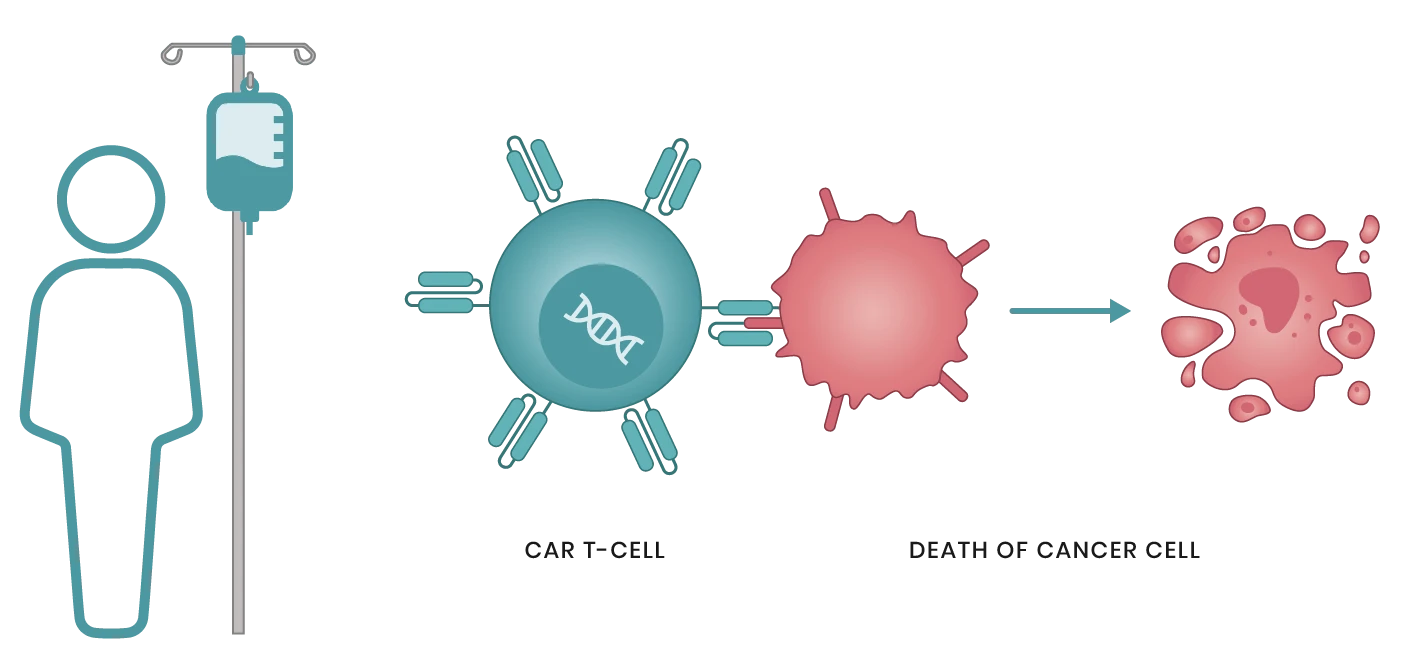
Chimeric Antigen Receptor T-cell (CAR T) therapy is a novel, personalized, and highly promising treatment approach for B-cell Malignancies and has been commercially available in the USA and Europe since 2017. So far, six CAR T therapies have been approved in the West; four of these targeted CD-19 antigen and two target BCMA antigen. CAR T-cell therapy is a novel treatment to fight some cancers. It involves using the patient’s own immune system to treat the cancer.
Mechanism of Action
- CAR T-cell therapy harnesses the power of the patient's own immune system to target and eliminate cancer cells. CARs are engineered receptors constructed from antigen recognition regions of antibodies fused to T-cell signaling and costimulatory domains that can be used to reprogram a patient's T-cells to specifically target tumor cells.
- CAR T-cells targeting CD19, a protein antigen uniformly expressed on B-cell malignancies, typically induce high complete response rates in patients with B Cell Non-Hodgkin Lymphoma who have very limited therapeutic options.
(Ref: Maus MV, Levine BL. Oncologist. 2016;21:608-617.)
Patient Selection
Patient selection for CAR-T cell therapy will be performed by a physician based on the:
- Disease subtype
- B Cell Non-Hodgkin lymphoma
- Performance status and biological fitness
- The physician ensures that the patient is biologically fit. The vital organs such as the heart, lungs, liver, and kidneys are functioning properly and there are no signs of active infections.
Manufacturing CAR-T cells
-
T-cell Selection and Activation
Autologous T-cells from apheresis are selected and activated with appropriate reagents.
-
Genetic Modification
A third-generation lentiviral vector is used for genetic modification.
-
T-cell Expansion
The selected, activated, and transduced T-cells are then expanded using the appropriate platform to generate a CAR T therapeutic dose.
-
Formulation
The final product is then formulated in bags in three fractions 10%, 30% and 60%.
-
Cryopreservation
The final product is cryopreserved and is thawed at the time of infusion.
-
Personalised autologous CAR T-Cell Product
A personalised autologous CAR T-cell product follows a robust chain of identity, custody, and condition process to ensure the right patient is always infused with right product.
CAR T-cell Therapy for Patients
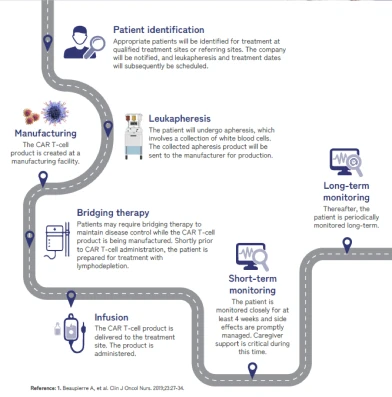
Steps to administer CAR T-cell therapy
Reach Out to Know More
To enroll yourself and your treatment center in our CellSpectrum Cell Therapy Program, please connect with us
Contact UsReferences
- Caballero-Baños M, Delgado J, Rives S, et al. Production of ARI-0001 cells (A3B1:CD8:4-1BB:CD3z CAR19 cells) in patients with CD19+ relapsed/refractory B-cell malignancies using the CliniMACS Prodigy System. Abstract PF405 EHA Annual Meeting 2018
- Delgado J, Rives S, Castella M, et al. CART19-BE-01: A European Academic Trial on The Use Of ARI-0001 Cells (A3B1:CD8:4-1BB:CD3Z CAR19 CELLS) in Patients with CD19+ Relapsed/Refractory Acute Lymphoblastic Leukemia. Abstract S835; EHA Annual Meeting 2018.
- Ortiz-Maldonado V, Caballero-Baños M, Bataller A, et al. Significant ARI-0001 (A3B1:CD8:4-1BB:CD3Z CAR19) Cell Expansion In A Patient With Refractory Chronic Lymphocytic Leukemia Through Pre-Lymphoapheresis Ibrutinib Administration. Abstract PS1153; EHA Annual Meeting 2018.
- Ortiz-Maldonado M, Alonso-Saladrigues A, Cardozo C, et. al. Infectious Complications Following ARI-0001 Cell (A3B1:CD8:4-1BB:CD3Z CART19) Treatment In Adult And Pediatric Patients With CD19+ Relapsed / Refractory Malignancies. Abstract PS1214; EHA Annual Meeting 2019.
- Ortiz-Maldonado V, Alonso-Saladrigues A, Caballero-Baños M, et.al. Fractionated Dosing Of ARI-0001 Cells (A3B1:CD8:4-1BB:CD3Z CAR19) And Early Tocilizumab Administration May Reduce The Incidence Of Severe Cytokine Release Syndrome In Patients With CD19+ Malignancies. Abstract: S1636; EHA Annual Meeting 2019.
- Delgado J, Caballero-Baños M, Ortiz-Maldonado V, et al. Chimeric Antigen Receptor T Cells Targeting CD19 and Ibrutinib for Chronic Lymphocytic Leukemia. Hemasphere. 2019 Feb;3(2):e174.
- Castella M, Boronat A, Martín-Ibáñez R, et al. Development of a Novel Anti-CD19 Chimeric Antigen Receptor: A Paradigm for an Affordable CAR T Cell Production at Academic Institutions. Mol Ther Methods Clin Dev. 2019;12:134-144.
- Castella M, Caballero-Baños M, Ortiz-Maldonado V, et al. Point-Of-Care CAR Tcell Production (ARI-0001) Using a Closed Semi-automatic Bioreactor: Experience From an Academic Phase I Clinical Trial. Front Immunol. 2020 Mar;11:482.
- Ortiz-Maldonado V, Rives S, Alonso-Saladrigues A, et.al. CART19-BE-01: A European Academic Trial On The Administration Of ARI-0001 Cells In Patients With Acute Lymphoblastic Leukemia And Other CD19+ Lymphoproliferative Disorders. Abstract S288; EHA Annual Meeting 2020.
- Ortiz Maldonado V, Rives S, Alonso-Saladrigues A, et.al. Factors Associated With Progression-free Survival (PFS) Of Adult And Pediatric Patients With Relapsed / Refractory B-cell Acute Lymphoblastic Leukemia Treated With ARI-0001 CART19 Therapy. Abstract EP734; EHA Annual Meeting 2021.
- Ortíz-Maldonado V, Rives S, Castellà M, et al. CART19-BE-01: A Multicenter Trial of ARI-0001 Cell Therapy in Patients with CD19+ Relapsed/Refractory Malignancies. Mol Ther. 2021 Feb;29(2):636-644.
- Ortíz-Maldonado V, Alonso-Saladrigues A, Español-Rego M, et al. Results of ARI-0001 CART19 cell therapy in patients with relapsed/refractory CD19-positive acute lymphoblastic leukemia with isolated extramedullary disease. Am J Hematol. 2022;97:731–739.
- Martinez-Cibrian N, Ortíz-Maldonado V, Español-Rego M, et al. Varnimcabtagene Autoleucel (var-cel) in Relapsed / Refractory CD19+ Non-Hodgkin Lymphoma. Abstract 1391; EHA Annual Meeting 2023